
DeepDojo.AIPublished 2026-11-08Updated 2026-11-09中文
Can You Trust an AI Answer? Check by Risk
Rewriting a routine reminder email in a politer tone usually needs nothing more than a comparison with the original sentences. But if the original mentions a compensation commitment, and the rewrite turns "we can discuss" into "we guarantee compensation," it could affect the contract talks.
Both jobs are called rewriting, and the consequences differ. So how closely you check an answer depends on what makes it hold up and what happens if you rely on it wrongly.
Tasks get sorted by risk first, then come three check prompts and a way to handle private material before you share it.
The same check should be applied with different force to different tasks. Start by sorting common situations into four kinds by risk, looking at what makes the result hold up and what happens if you rely on it wrongly, then decide how closely to check and what a professional should confirm.
Errors often come from an unclear task, gaps in the material, or old material mixed in, and tracing back along those gaps beats checking word by word.
Before you hand over any material, think it through too: ID numbers, client privacy, and unpublished contracts raise the questions of whether you can share them and what happens if you do, and removing the sensitive parts first is the safer way to give them to an AI.
01 Match the check to the task's risk
Judging risk takes two questions together: what makes the result hold up, and what happens if you use it and it's wrong. However natural the tone, facts still need checking, and the risk comes from the specific content, not from the task's name.
Start with four kinds of task to set the main direction for checking:
| Type | Typical task | Main evidence and check |
|---|---|---|
| Low-risk expression | Ordinary emails, titles, and copy revisions | Check original meaning, tone, and existing facts |
| Document organization | Summaries of articles or meeting notes; action extraction | Return to the source for omissions, conditions, and added information |
| Fact lookup | Policies, prices, news, and product features | Check reliable sources; current facts also need dates and scope |
| High-risk decisions | Medical, legal, financial, contractual, or compliance judgments | Claude helps organize; relevant professionals or authoritative channels confirm |
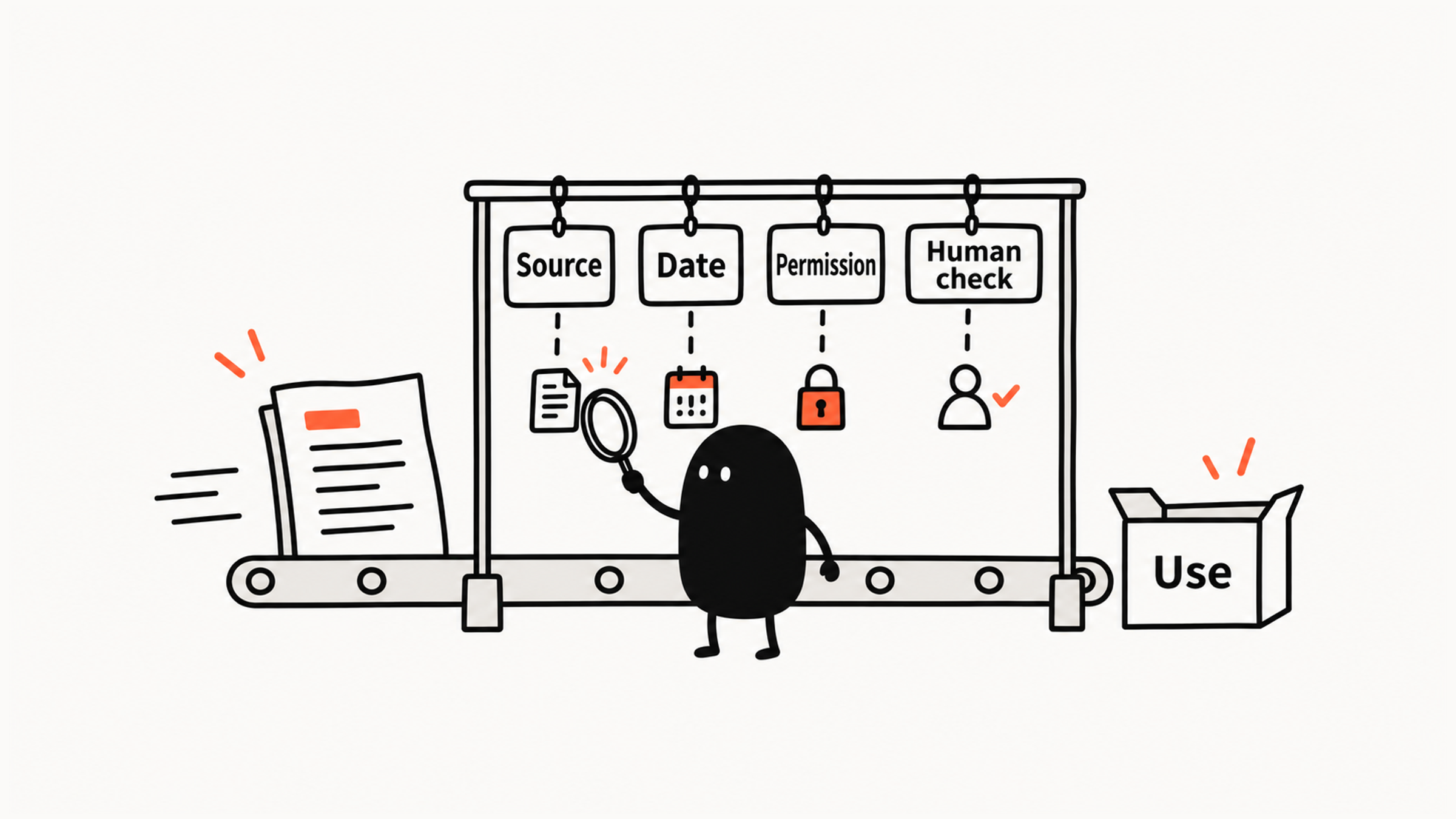
One task can fall into several types. A client email that cites a recent policy needs both its expression checked and the policy verified. For a shorter pre-publish checklist with four steps, see Starting with AI: A Four-Step Final Check.
02 Where errors can come from
Claude generates answers from the task description and the information currently available to it, so errors usually come from these four places:
| Influence | How a gap reaches the result | Where to address it |
|---|---|---|
| An unclear task | The model chooses the goal, reader, or format itself | Add requirements that change the answer |
| Missing or conflicting background | It uses the wrong role, rule, or version | Supply current background and identify valid agreements |
| Unreliable materials | It carries outdated, missing, or conflicting information into the output | Check sources and preserve disagreements and unknowns |
| A current question without current sources | It answers a changed situation from existing knowledge | Search and check dates and applicable conditions |
Take turning meeting notes into action items. Even after you've asked "mark missing owners as not specified," you still have to check whether the output assigned an owner on its own. A clear request cuts down ambiguity in the task, but facts depend on the material. Only by checking item by item against the notes can you tell whether this run was done right.
Keeping instructions, background, input material, and examples apart also reduces misuse. A made-up client in an example only demonstrates a format. An old price list should be labeled with its date and kept separate from new promotional commitments.
When you check, look first at whether the material itself is reliable, then at whether the answer used it accurately. Reliable material can be misread, and wrong material can be organized into smooth prose. Check both.
03 Check the content, and check the actions
A hallucination is an answer that looks credible but may be wrong or unsupported. Here the focus is on how it shows up: made-up sources and data, or guesses written as certainties. For the basics of hallucination and how it differs from search and fixed software, see AI vs. Search Engine: Which One Fits the Job?.
Names, organizations, dates, and figures especially need a source, however precise they look. Pick one name, date, or number from an AI answer you've received and trace it back to the original or the source. That tells you how reliable this kind of answer is.
Other errors come from handling the material. Miss the condition "once the budget is approved," and a topic still up for discussion becomes a formal decision. Mix two documents, and Project A's requirements can end up in Project B.
Check external actions separately. When an answer says something was done, go to the system and look at the result:
"I sent the email"         -> Check the email account.
"I saved the file"         -> Look for an actual file.
"I found the latest info"  -> Check whether search was actually used.
An email counts as sent only when the sent record shows it, and conclusions that came from a search still need checking one by one.
04 Three check prompts
Anthropic's guide to reducing hallucinations lists a few basic practices: let the model say "I don't know," extract word-for-word quotes first when working with long documents, then have it find a supporting quote for each claim and retract any it can't support. The three prompts below follow those practices.
1. Mark uncertain information
If you are uncertain, say "uncertain" directly rather than guessing.This lets the model say outright that it doesn't know. It can also misjudge how certain it is, so content not marked "uncertain" still needs checks that match the task's risk.
When the work is limited to material you supply, add:
Answer only from the material I provide, without using outside knowledge.
If the material does not contain the answer, write "not mentioned in the material."
"Not mentioned" says only that this source can't answer the question, and the answer may be elsewhere. A deadline missing from the meeting notes should be marked as awaiting confirmation.
2. Check the evidence for conclusions
First extract the sentences in the original that support the conclusion, then summarize.
Do not add claims that have no support in the original.
Locate the source sentences first, then check whether the summary keeps the subject, the action, and the conditions. That cuts down the checking you'd otherwise do afterward. Quotations can also be inaccurate, so compare important ones with the original.
When you need analysis too, you can ask:
Divide the answer into three parts:
1. Content from my materials.
2. Your inferences.
3. Information I need to verify further.
That lets the reader see which items have direct support and which are only interpretation or advice. "Users said the price was high" is a recorded observation. "Lowering the price will increase conversions" is a separate claim to test. Write the two separately.
3. Check recency, actions, and professional judgments
For "now," "latest," "recent," or "launched this year," use Web Search to get current sources. Choose Research when several aspects need investigation and synthesis. For how to choose between the two, see Picking the Right AI Feature for Each Kind of Task.
Once you have a source, look at three things: the publisher, the date, and the scope. For important conclusions, cross-check against independent reliable sources when needed. Many pages repeating one claim count as one piece of evidence.
When you add sources to an article, open the original source and confirm that it exists and supports the conclusion. If you can't find it, keep looking for reliable evidence, and if you still can't find it, say the support is insufficient.
For answers that claim to have sent, saved, accessed, or run something, the method is the one above: fact-checking asks whether a claim holds, and a system check asks whether the action actually happened. You need both.
For tasks with serious consequences, also hand the conclusion to the relevant professional or the person responsible. Claude can help prepare the consultation materials.
05 Protect privacy before you share material
ID numbers, bank card numbers, passwords, client privacy, trade secrets, unreleased contracts, and medical record details all need a decision before you enter them. First confirm your account type, your organization's policy, and your privacy settings. Then ask two questions: do I really need to share this? Am I allowed to use it in this tool? If either answer is "no," don't upload it yet.
Delete what you can. Where you need to keep relationships, use stand-in labels. In a client email, names, phone numbers, and contract numbers can become "Client A," "contact info removed," and "Contract B," and amounts can become "Amount X."
Anonymizing has to account for combined information. Remove a name but keep a unique order, a full address, and event details, and a person may still be identifiable. Provide only what the current task needs, then check whether the remaining details taken together could still identify a real person.
After editing, read it once more and ask whether someone who knows the situation could guess who it is. If they could, keep editing.
If a task truly needs protected material, first meet your organization's actual requirements and permissions. Telling Claude it's "confidential" is only a request, and how data is handled follows your organization's rules. For specific rules at four points (uploading, using facts, publishing, and important decisions), see A Seven-Day Plan for Learning AI From Zero.
06 Choose checks by risk
When you judge the risk of a task, record three things for each one so you can look back later:
- What could go wrong, for example a dropped condition, outdated material, or an added commitment.
- What the real consequences of an error would be, and who is responsible for deciding to use the result.
- Which check to run before you use it, and how you'd find and handle the error.
You can summarize the outcome as a risk level and write down the specific reasons and check actions. For example, change "use its summary of the policy as is" to "check the current official document, its scope, and its date first, then use the parts that have support," and the next step is clear.
Your check records also show what to practice next. If you keep dropping conditions, practice comparing against the source. If you keep using old material, practice checking recency. If you treat a reply as done, practice checking the system's actual result. The record decides which comes first.