
DeepDojo.AIPublished 2026-11-08Updated 2026-11-09中文
AI vs. Search Engine: Which One Fits the Job?
Claude can write, explain, and look things up, so it sounds like it can do everything. The most common beginner mistake is to treat it like a search engine or a calculator.
Used in the wrong place, it still gives you an answer that looks right. The example below shows which step Claude helps with, what you have to supply, and what you have to check.
The same method works with other AI assistants.
An example makes it concrete. A newly hired operations employee has to hand in an event retrospective tomorrow. They know what happened at the event but not how to organize the report, so they ask Claude for a framework, and it helps.
The facts that go into the framework, such as attendance and conversions, exist only in the employee's own records. Compare that with a search engine and with fixed software: a search engine tells you where information is, fixed software follows set rules, and Claude composes an answer from what you say and the information at hand, so the same question phrased differently can get a different answer.
Split the task up and it's clear which step to hand over and which to check yourself. Claude sometimes states something wrong with full confidence, so how much you check should follow the task.
01 How a small task divides up
Suppose a new operations employee has to hand in an event review tomorrow. They know what happened at the event but not how to organize the report, so they ask Claude:
I'm new to operations and need to write an event review tomorrow. I don't know how to structure it. Please give me an outline first, then explain what belongs in each section.Claude can suggest sections such as goals, results, problems, and next steps, and say what goes in each. With that outline, the employee can add the event records, check the facts, and revise as they go.
Attendance, revenue, and user feedback can only come from the employee. A heading like "Number of registrations" is a reminder to supply that figure. If Claude fills in a number itself, find out where it came from.
Claude is an AI assistant that answers from your plain-language request and whatever information it can currently use, helping you get tasks done. Plain language is enough to describe a problem, supply material, and make a request.
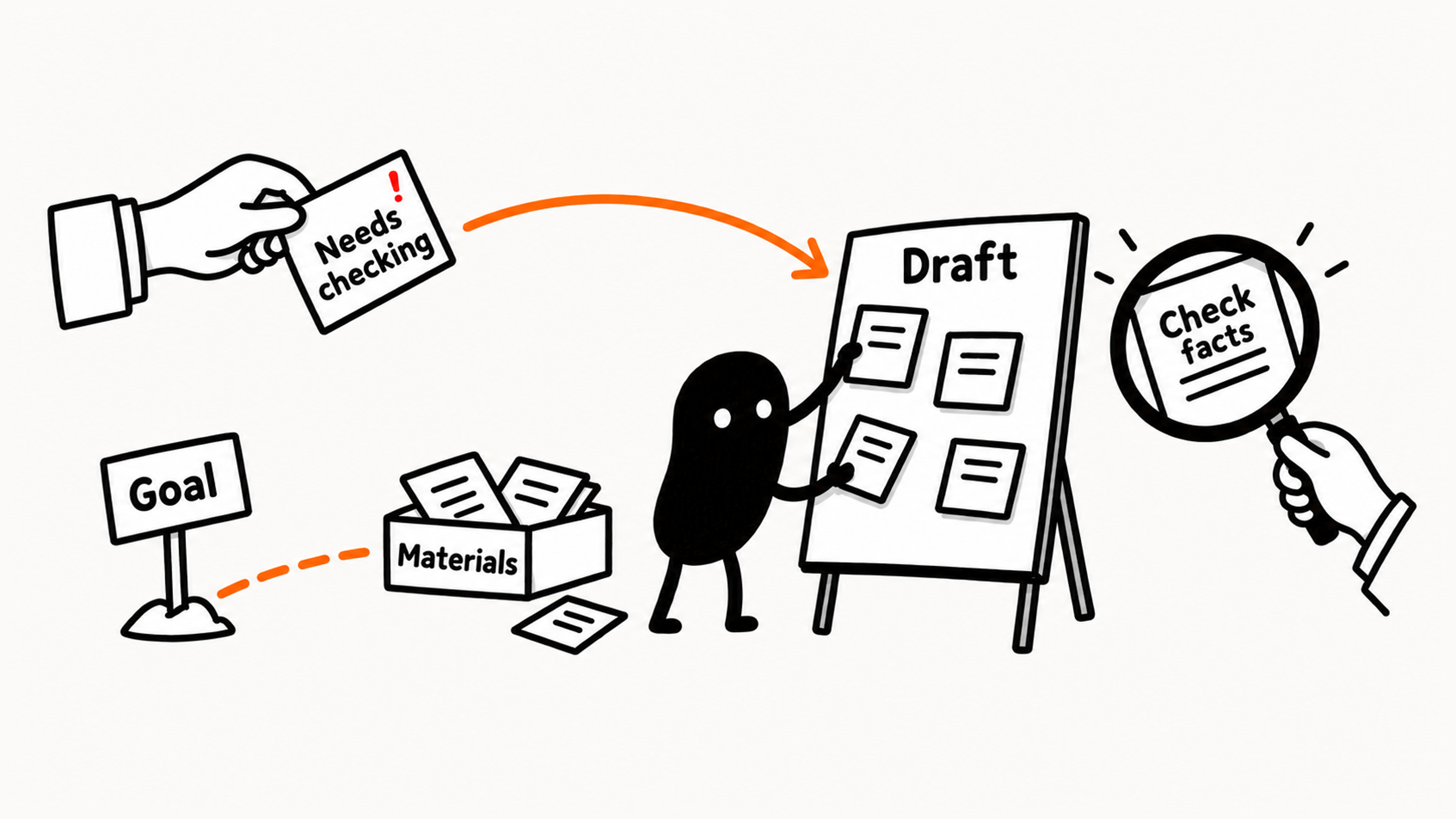
In this example, the employee knows the event facts, Claude helps organize a draft, and the employee decides what to use. Your own tasks need the same division of work. The job continues after the reply arrives:
The structure works         -> keep it
Facts are missing           -> supply the material
The wording misses the use  -> point to the spot and keep revising
02 Describe the task first, then check the result
Claude can misread a request or get a fact wrong, so describe the task clearly and check what comes back.
"Help me write an event review" leaves several questions open: who will read it, what matters most, and which records it can draw on. Claude may ask, or it may fill the gaps with its own assumptions and produce generic content. Staying with the event review, you can state the purpose:
This event review is for the operations manager. Focus on the event's goals, actual results, and problems to address.
Using the event records I will provide next, outline those three sections. Mark anything the records do not support as "Information needed."
Now you can check three things: whether the structure suits the manager, whether each point has support, and whether the missing information is marked.
A clear request cuts down guesswork, but you still supply the data. Include only the background that relates to this review.
03 Claude, search engines, and fixed software
Typing "What is Claude?" into a search engine usually gives you web pages that you open, compare, and judge for yourself. Asking Claude to explain itself to a complete beginner, with three examples, is a request to organize an explanation. The search finds where information comes from, and Claude's answer presents information for a particular reader.
Claude can also find sources when web search is available and actually used. According to Claude's Help Center page on web search, answers from a search come with citations. To know whether it searched and whether the information is current, look at the sources and dates it lists. For a time-sensitive question like "Which AI tools are worth watching this year?", the order is:
Current sources and dates first -> compare their uses -> only then a judgment for this yearClaude can search and help organize the results, but you still have to check the sources. Fixed software operations process their inputs by predefined rules:
Click "Bold"           -> change the text formatting according to the setting
A SUM formula          -> calculate from the supplied values and formula
"Make it more formal"  -> interpret a request and generate one possible version
For exact calculations, verify the numbers with a spreadsheet formula or another deterministic operation, and check the inputs and the formula too.
| What you need now | Main capability involved | How to assess the result |
|---|---|---|
| Find out whether a policy is still in force | Looking up current authoritative sources | Check the issuing body, date, and scope |
| Explain an article to a beginner | Claude's explanation and rewriting | Compare with the original for meaning and conditions |
| Total a column with a defined formula | Rule-based software calculation | Check inputs, formula, and result |
| Decide about medication, a contract, or a major financial action | Reliable information and the relevant professional judgment | Verify individual circumstances; the responsible person decides |
These capabilities can work together. Search engines can generate answers, traditional software can include AI, and Claude can use tools. Pick based on the capability and evidence the current step needs.
04 Which tasks to hand Claude first
When you're starting out, look at the task in front of you and ask which step Claude could help with.
| Task type | Steps Claude can help with | What you check |
|---|---|---|
| Writing and rewriting | Structure emails, notices, reports, and article drafts | Meaning, audience, and tone; for complex material, check the structure first |
| Learning and explanation | Explain an unfamiliar concept through examples | Whether the example fits the concept; compare with reliable learning materials when needed |
| Summarizing and organizing | Extract information from articles, meeting notes, and feedback | Whether the points come from the source and important conditions survived |
| Checking and improving | Review copy, plans, or instructions against stated criteria | Whether the problems are real and whether revisions keep the intended meaning |
Start with one step you can verify. To find such a step in your everyday work, see Your First AI Task Is in What Stalled You Last Week.
05 Check an answer before you use it
A model can state incorrect or unsupported claims with total confidence. This is often called a hallucination. However sure and well organized an answer sounds, a fact counts only after you've verified it. Anthropic's guide to reducing hallucinations says the same of even the most advanced models, Claude included: they can produce text that is factually wrong or inconsistent with the material they were given.
Choose checks that fit the task:
- For an email rewrite, check whether the meaning, tone, or commitments have changed.
- For an article summary, compare the main points and conditions with the original.
- For a current policy or today's market changes, check sources, dates, and scope, then separate facts from possible explanations.
- For important decisions about medication or contracts, ask a qualified professional to assess the specific circumstances.
Claude can organize questions, explain materials, and help you prepare for a consultation. You and the people responsible still decide whether to use or send a result, or to make an important decision. How closely to check depends on how the result will be used and what an error could cost. For how deep to go on each kind of task, see Can You Trust an AI Answer? Check by Risk.
When you explain this to a beginner, you can compress it into a few sentences:
Claude is an AI assistant you can talk to in everyday language. I describe a task and provide relevant material, and it can help organize meeting notes, rewrite an email, or explain a concept. I then check whether the result serves my purpose and keeps the facts straight. Current information and important decisions also need reliable sources or professional confirmation.
That paragraph covers three things: what to provide, which step Claude helps with, and what to check afterward. A first-time user can get started with those three.