
DeepDojo.AIPublished 2026-11-06Updated 2026-11-07中文
Before Using AI Output: A Four-Step Final Checklist
Once major flaws are resolved, it is tempting to breathe a sigh of relief and send the revised draft immediately. Many missteps happen in these final seconds. The previous round of editing only answered: "Did we fix that specific flaw?" The real question before hitting send is: Is this draft safe and practical to use in the real world right now?
Even when text reads smoothly after an edit, subtle risks can remain. Before publishing, submitting, or sending an AI-assisted document, place it side by side with your source notes and run through these four pre-flight checks:
- Check facts: Is every detail accurate? Are times, locations, and numbers supported by source notes?
- Check for omissions: Working backward from reader actions, are all necessary details present?
- Check for ungrounded additions: Did the model introduce promises or claims not found in the source material?
- Check risks: Have privacy concerns, commitments, time sensitivities, and expert judgments been handled appropriately?
01 Fact Check: Verifying Key Data
Dates, locations, names, numbers, fees, deadlines, and commitments must have verifiable sources. There is no room for "close enough." Take your revised draft and match each statement against your verified source material.
Consider our revised community reading notice:
This Saturday from 3:00 PM to 4:00 PM, a Family Reading Session will be held in the Community Activity Room for children aged 6 to 10 and their parents. Please arrive 10 minutes early with a favorite book. Please sign up in the group chat by Friday, 6:00 PM.Extract the facts from the draft and compare them against your original six notes:
| Content in Draft | Source Evidence | Verification Result |
|---|---|---|
| "Family Reading Session" | Original event title | Matches |
| "Saturday, 3:00 PM to 4:00 PM" | Original time range | Matches |
| "Community Activity Room" | Original location | Matches |
| "Children aged 6 to 10 and parents" | Original audience | Matches |
| "Bring a book; arrive 10 min early" | Original preparation note | Matches |
| "Sign up in chat by Friday, 6:00 PM" | Original registration note | Matches |
When checking times, avoid glancing at "Saturday afternoon" and moving on. Check the three components: Which day? What time does it start? What time does it end? Leaving out an end time forces parents to ask follow-up questions in the chat. When all three match your schedule, families can plan their day with confidence.
02 Backward Audit: Catching Omissions from Reader Steps
Verifying written facts is straightforward; catching missing information is much harder because absent details leave no visual trace on the page. Even if times and locations are accurate, omitting sign-up steps leaves readers stuck. Shift perspectives and imagine reading the notice as a recipient:
- Do I know what this activity is?
- Can I determine whether it fits my family?
- Do I know when and where to go?
- Do I know what we need to bring?
- Do I know how to register and when sign-ups close?
The revised draft answers all five questions: activity, audience, logistics, preparation, and registration are all accounted for. Reviewing the text against the reader's intended actions reveals omissions that a simple proofread might miss.
03 Hallucination Filter: Purging Invented Claims
AI models frequently insert common marketing clichés like "limited spots available," "free admission," or "complimentary books provided." In NIST AI 600-1 (Generative AI Profile), this tendency to generate confident, context-appropriate claims without factual backing is classified as "confabulation." Because these phrases sound familiar and pleasant, reviewers often glide right past them. But if your notes didn't promise free books, families who arrive expecting them will leave organizers in an awkward spot.
Read the draft sentence by sentence against your notes, paying close attention to fees, headcounts, dates, and promises. Whenever a new commitment appears, ask: can the organizer actually deliver this? If you encounter unconfirmed details, handle them systematically:
| Encountered Detail | How to Handle It |
|---|---|
| Ungrounded claim ("books provided") | Delete; source notes state attendees bring their own |
| Unconfirmed event location | Mark as "To be confirmed" in draft; verify with organizer before finalizing |
Logistical details like event locations must be confirmed. Until confirmed, keep the text in your drafts folder, and never publish assumptions as settled facts.
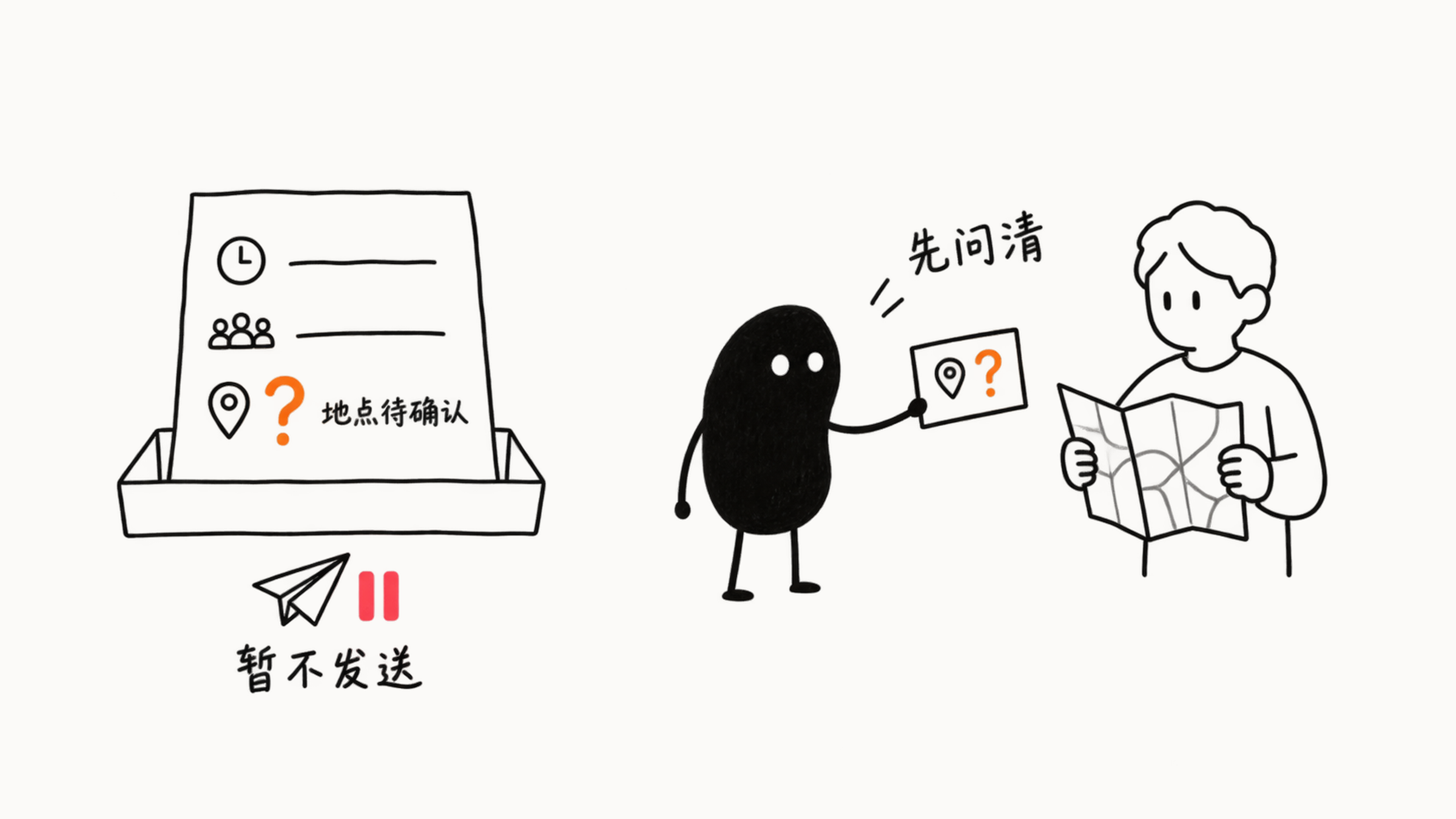
When key details remain unconfirmed, hold the announcement in your drafts folder and check with organizers to avoid circulating guesswork.
04 Risk Review: Screening Privacy and Real Fallout
Even if the text is factually accurate, consider the broader context: where did the input data go, and who will read the output? Data privacy requires vigilance at both ends:
- Before submitting context: Is this information safe to enter into the chosen AI tool? Anthropic's official privacy documentation shows that data handling rules differ between consumer accounts and commercial or enterprise plans: depending on the tool, tier, and settings, prompts may be logged or used for model training. Strip unnecessary personal details and replace real identities with placeholders before sending prompts.
- Before distributing output: Is this content appropriate for the recipient? Screen for inadvertent disclosures and share only with the intended audience.
Other practical risks also require careful consideration:
| Risk Category | How to Address Before Distribution |
|---|---|
| Pricing, delivery dates, refunds, limits | Confirm with the responsible individual or team before publishing |
| Dynamic facts (policy, rates, hours) | Verify against current official sources and record the verification date |
| Legal, medical, financial analysis | Use AI to outline questions and organize notes; confirm all conclusions with qualified professionals |
Our community reading notice uses established schedule notes and involves no sensitive personal data or high-stakes judgment. Before sending, perform one final sanity check on the calendar: do "this Saturday" and "Friday" match the intended calendar dates? Once verified, the notice is ready to go.
05 Action Decision: Choosing from Three Outcomes
When multiple rounds of editing wrap up, there is natural pressure to send the text and move on. But drafting issues and unconfirmed facts often sit side by side. Awkward phrasing can be edited on the spot if you have the context; missing operational details mean the text must stay in your drafts folder, no matter how urgent it feels. Holding the draft prevents distributing misinformation.
| Decision | When It Applies | Next Step |
|---|---|---|
| Use immediately | All facts verified, necessary details present, risks addressed | The person responsible for the outcome sends or publishes |
| Revise further | Issues are known and fixable with more context or editing | Make the edits and re-run the verification checklist |
| Seek confirmation | Key facts, commitments, or expert judgments remain unverified | Check with organizers, primary sources, or professionals |
Having passed all four checks, our example notice is ready: event title, time, location, audience, preparation, and registration match our notes, with no omissions or fabrications. Once calendar dates are confirmed, it can be published.
06 Habit Building: Establishing a Reliable Workflow
From your initial prompt to final approval, these steps form a practical routine for working with AI without losing control:
- Select the task: Assess error consequences, available materials, review methods, and accountability; see Starting with AI: How to Pick a First Task;
- Structure the prompt: Separate action, source context, intended audience, and verifiable constraints; see Prompting AI: Four Elements of a Clear Request;
- Review the first draft: Use source notes and real-world actionability to pinpoint issues; see Reviewing AI Drafts: Catching Omissions and Fluff;
- Iterate with focus: Preserve accurate text, target specific changes, and compare versions objectively; see Iterating with AI: How to Steer Revisions Accurately;
- Pre-flight review: Check facts, omissions, fabrications, and risks to decide whether to use, revise, or verify further.
Whether you are organizing meeting notes, drafting team updates, or comparing proposals, the core workflow remains the same. The materials and audience will change with every task; the responsibility to verify and approve the final result remains yours.