
DeepDojo.AIPublished 2026-11-08Updated 2026-11-08中文
Vague AI Answers Usually Start With a Vague Request
When Claude writes a weekly report that looks complete and says almost nothing, the cause is usually a request that was only "Please help me write a weekly work report." That line can open a conversation, and Claude may ask about your work. But it doesn't know who will read the report, what you did this week, or what the reader cares about. It fills those gaps with assumptions, and the result doesn't match what actually happened.
One weekly report runs through the whole piece. Five kinds of information show what a request is missing, and three rounds show the gaps filling in. You can start with a short question and add details once you see the gaps, or send the full request at once if you already have the information. The weekly report is only an example. To choose your own first task, see Your First AI Task Is in What Stalled You Last Week.
01 A clear request has five kinds of information
A prompt is the input you send to Claude. Here it mostly means a question or a task description. It can be a short question, or it can include the task, the material, and the requirements. When you write one, state the task clearly first.
Anthropic's prompting guide compares Claude to a capable new colleague who doesn't know your norms or workflows: the more precisely you explain what you want, the better the result. It also offers a test. Show your request to a colleague who knows little about the task and ask them to follow it. If they'd be confused, Claude will be too.
To check whether a request is clear, sort its information into five kinds:
| Information | Question it answers | Role in the weekly report |
|---|---|---|
| Background | What is the current situation? | An operations assistant is reporting to their direct manager |
| Goal | What change should the work achieve? | Help the manager see this week's progress and problems |
| Task | What action should Claude take now? | Draft the report from the work notes |
| Criteria | What makes the result suitable? | Supported facts, concise wording, no exaggerated achievements |
| Output format | How should the information be presented for use? | Completed work, problems encountered, and next week's plans |
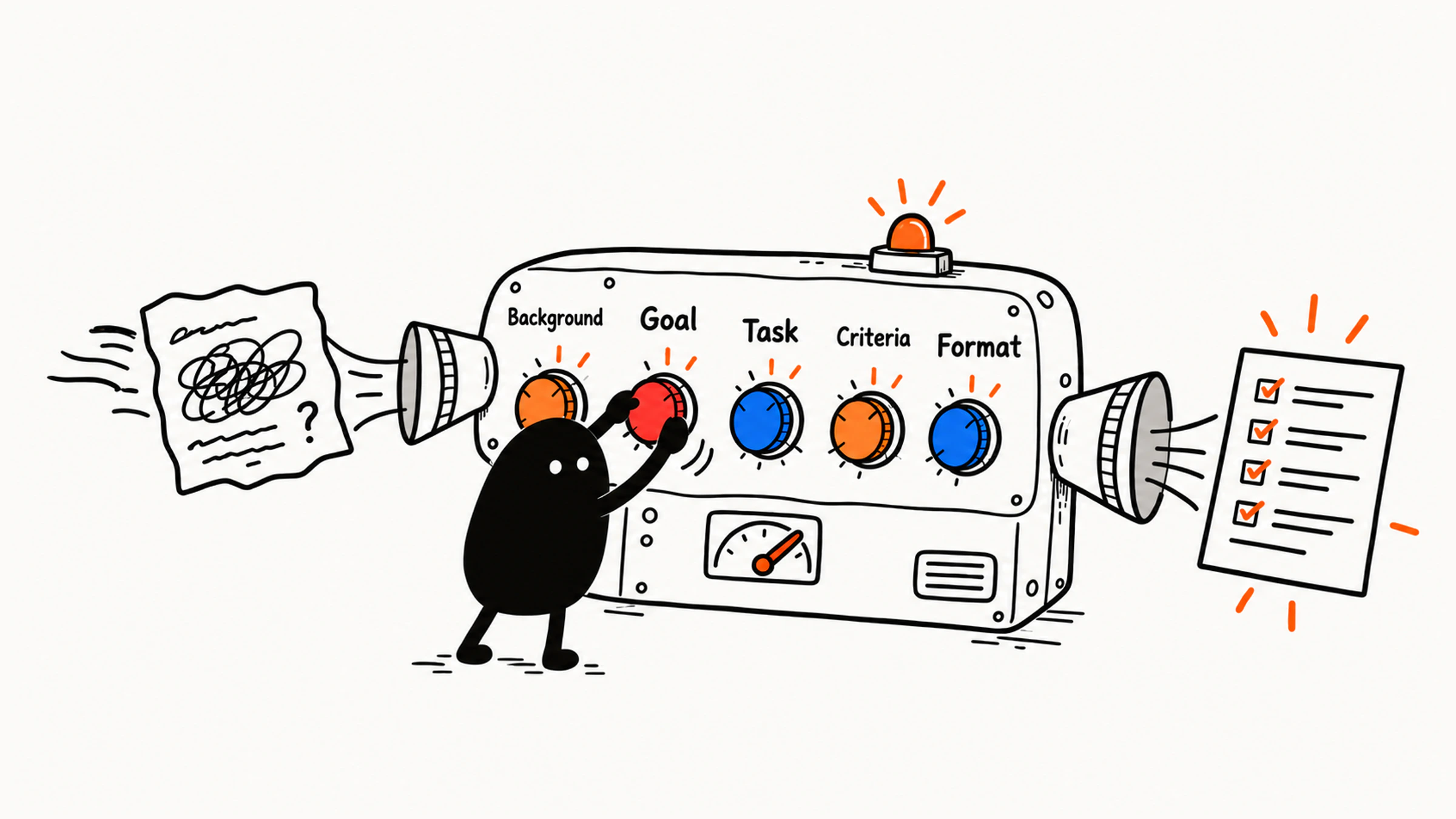
Goal and task are the easiest to confuse, so separate them. "Understand a concept" is the change you want. "Explain it and give examples" is the action you're asking Claude to take now. Criteria decide whether the result is acceptable, and format decides how it's organized. That's why a neatly formatted report still needs a check for exaggerated results.
These five are angles for checking a request, and you can use the ones the task needs. "Output requirements" can cover both criteria and format, so write a repeated requirement once. Keep only the identity, role, and background that affect the result. For a version with four elements, see Starting with AI: How to Write a Clear Request.
Material and task are also different things. Meeting notes are the thing to be processed, and "extract the action items" is the instruction. After you paste in the original text, say whether you want a summary, a translation, or a check.
02 Three rounds to improve a weekly report
1. Round one: find the information gap
Round one reuses the opening line, "Please help me write a weekly work report." It supplies no actual work and no reader requirements.
Claude might return generic lines such as "completed key work and continued to improve efficiency." It looks like a weekly report, but it has no real events and doesn't address a specific reader. The next step is to add the work facts and the reader.
2. Round two: add the task information
I've been working as an operations assistant for two months.
This weekly report is for my direct manager.
This week I mainly organized user feedback, followed up on community activities, and helped create course posters.
Please draft a concise weekly report.
Use three sections: completed work, problems encountered, and next week's plans.
Keep the tone formal without exaggerating.
Now the role, the reader, the three activities, and the structure are set, and Claude has something to build a draft around. Two sections are still empty, though: what problems actually occurred, and which plans for next week are agreed. The request hasn't supplied those facts.
Section headings only say where information goes. The facts still have to come from you. Mark unconfirmed problems or plans as "Information needed," and fill them in once you confirm.
Suppose a sample draft says, "This week, I efficiently resolved all user feedback and significantly increased campaign conversion rates." The request only mentions organizing feedback and following up on activities. It never says every issue was resolved, and it gives no conversion data. The draft exaggerates the results.
3. Round three: fix the specific problem
You could follow up like this:
Keep the three-section structure. Replace "resolved all user feedback" and "significantly increased campaign conversion rates" with the actions I actually provided. Do not add unsupported achievements.
Leave "problems encountered" and "next week's plans" marked for completion until I confirm the details.
This follow-up keeps the three-section structure, swaps the exaggerated results for known actions, and marks unconfirmed facts for later.
State the specific problem, the requested change, and what to preserve together, so you can see what the next round fixed.
03 The framework finds gaps, and you supply the facts
A request framework shows what's missing, but you provide the facts. Look back at round two. The role, the reader, three activities, and the three-section format were all given, yet the problems and plans were still missing. Complete headings and complete evidence are two different things.
Suppose the assistant later confirms: "User feedback hasn't been categorized yet. Next week I'll group it by theme first." That new information can go into the problems and plans sections because it adds real evidence. If you only say "make the plan more specific," Claude has to guess.
04 Pick a follow-up that fits the gap
Look at where the output and your requirements disagree, then decide what kind of change to ask for:
| Gap you find | What to add or change | Basis for checking |
|---|---|---|
| Too generic | Add circumstances that change the answer, and point to the unsuitable passage | Whether it fits the actual audience and use |
| Abstract phrases without actions | Supply real material and ask for concrete actions | Whether you can see who should do what |
| Hard to use | Request a table, list, three-part structure, or several versions | How you will copy, compare, or follow up on it |
| Questionable facts | Ask for support and uncertain points, then check independently | Whether the material or reliable sources back up the claims |
When the content involves data, policy, medicine, law, finance, or recent information, you can ask:
Mark the factual claims in this answer that I need to verify further.That helps you find what to check, but watch for claims it leaves unmarked. Confirm important facts against the original material, current reliable sources, or a qualified professional. Once the request is clear, the full path from goal to saved result is in AI Drafts Usually Go Wrong at the Earliest Step.
05 What each round added
The three rounds are only a practice setup that shows how the collaboration changes, and the round-three result needs checking too. Round two should fill in the important unknowns. Round three should address an actual response, or one clearly labeled as a sample. When a new requirement conflicts with an old one, say which takes precedence.
For example, you first ask to "keep every meeting item," then later ask for "only three items." For a manager reading quickly, you could say, "For this round, the three-item summary takes precedence, and I'll keep the full list separately." For a team that has to follow up on everything, keep the full list. Naming the priority for this round is more reliable than leaving Claude to guess which items to cut.
Look back over a conversation and say what each round added and which guess it removed. "Round two added three activities, and round three removed an unsupported achievement" tells you more than "round two was better."
The last round's output is still a candidate. Check it against your requirements before you use it, and if real plans are still missing, keep supplying material.