
DeepDojo.AIPublished 2026-11-08Updated 2026-11-10中文
Your First AI Task Is in What Stalled You Last Week
Open Claude and ask:
What can you do?It may list writing, summarizing, translation, learning, coding, brainstorming, and image analysis. Every item is true. Your real question is different: which item from today's workload can it take first? Start from something that recently stalled you, narrow it to a small task, and use five criteria to decide whether it's worth practicing first.
Fitting "what can it do" into a concrete task is what makes the answer useful. Say you always scramble to put together a weekly report on Fridays. What is actually stuck is that your work notes are scattered and the key points unclear.
Claude can organize the structure and pull out the key points, and the person writing the report checks against the notes. Switch to a client email and the help changes: keeping commitments already made and adjusting the tone.
To find a first task, there is no need to invent an "efficiency project." Look at what stalled you in the past week, and the material is often already in hand. Shrink it into a small task, then run it against a few criteria to see whether it's worth practicing first.
01 Put a capability inside a specific task
Take a weekly report. If the notes are scattered and the priorities unclear, Claude can organize them and pull out the main points, and the person writing the report checks it against the notes. A client email may instead need a softer tone while keeping the commitments already agreed. Both are writing, but the materials, difficulties, and checks differ, so the help differs too.
A use scenario places a capability inside a specific task: who is working on what, which materials they have, what action they need, and where they'll use the result. Once you've described the difficulty, it's clear where Claude can contribute. Who handles generating, finding sources, and fixed operations is covered in AI vs. Search Engine: Which One Fits the Job?.
"Use this week's work notes to prepare a report for my direct manager" already states the material, the action, and the use.
02 Find a task in something that got you stuck
To find a first task, start from where you got stuck in the past week. Recall one specific episode, then decide which capability it needs:
Which tasks do I repeat every day?
Where do I often struggle to get started?
Which materials do I struggle to finish reading or organize?
Which writing or communication tasks do I keep putting off?
Which topics do I keep finding difficult to understand?
Say you remember piecing together a report every Friday. Find your work notes and start there. With the material already in hand, that's easier than inventing a "productivity project" from scratch.
Next, narrow it. "Prepare for a client meeting" is too broad. Narrow it to "Use the client's known requirements to list the questions I need to confirm during the meeting." Now you have material to provide and an action to request.
Pull one step out of the larger goal, a step that language or information processing can move forward. Preparing questions for a client meeting is such a step. A person still conducts the meeting.
03 Five criteria for a first task
A real need isn't automatically a good first exercise. Take the weekly report. If you ask Claude to write the whole week from scratch, it has no facts. Hand it one page of notes and ask for "Completed work, Risks, Next week's plans," and both the material and the result are clear.
For a first exercise, choose a small task. When something goes wrong, the cause is easier to find and the fix is easier to make.
Work through the checks in this order:
| Check | Question to ask | Evidence in the weekly report example |
|---|---|---|
| Scope and contribution | What step fits a short attempt? Is it language or information processing? | Organize one page of notes instead of designing a whole performance system |
| Materials | Can I supply the source, draft, or facts the task needs? | Work notes provide real events; missing information is marked for completion |
| Revision | If the first version is off, can I point to something specific to change? | Reorder, shorten the report, or highlight risks |
| Checkability | How will I know whether it is correct? | Compare each item with the notes for omissions, invented facts, and structure |
| Consequences | Could an error cause lasting harm before I catch it? | Review the draft and confirm it yourself before sending |
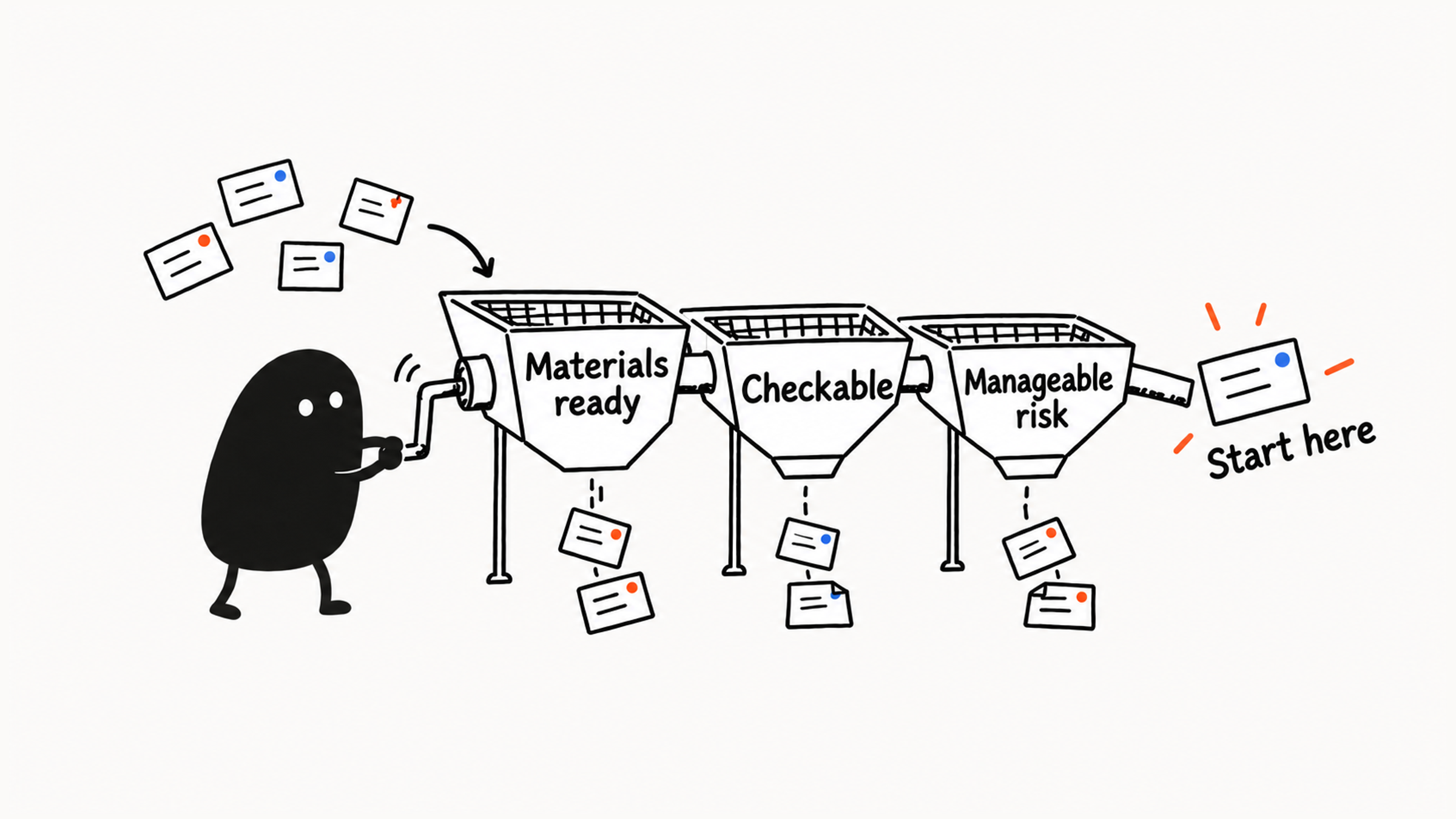
Read the five together. If you can't answer one of them, narrow the task or pick another. For a screen that uses only three criteria, see Starting with AI: How to Pick a First Task.
For a concept-learning task, look hardest at checkability. Asking for examples and common mistakes helps you understand, but Claude's further explanations come from the same source. A definition has to be checked against a textbook or another reliable source, so choose a concept you can compare with one.
Medical, legal, financial, policy, and contract tasks can be narrowed first: organize your questions, summarize existing material, prepare for a consultation. The final professional judgment belongs to authoritative sources and qualified professionals. If you can't verify an answer and would act on it directly, pick a different beginner scenario.
Suppose you want help with both a routine reminder email and a contract you don't understand. Compare the two:
- You can rewrite one paragraph of the email, then check it against the original for added dates or commitments. Errors are fairly easy to spot.
- Even a one-page contract is hard to judge, and acting on a wrong explanation costs more.
So start with the email. If the contract is urgent, Claude can help list questions for a lawyer, who still gives the professional assessment. A short contract can be harder to check than ten emails.
Claude’s official explanation of incorrect responses advises scrutinizing high-stakes advice, supporting the choice to start with a small task you can check yourself.
04 The purpose decides the treatment
The same page of work notes could become a weekly report or a list of follow-up actions. The report tells your manager how the work is going, and the action list helps you follow through. The purpose changes what you check:
| Purpose | What Claude does | What you check |
|---|---|---|
| Report this week's progress | Group completed work, risks, and plans | Whether the content matches the notes and highlights what the manager needs |
| Follow up on work | Extract actions, owners, and dates | Whether the arrangements are confirmed and missing details are marked |
If the notes give no owner or date, mark them "to be confirmed."
Explanations, summaries, and rewrites usually narrow down to one concept or one passage. Summaries and rewrites can be compared with the source, and explanations with reliable learning materials.
05 Turn a scenario into a concrete task
These broad intentions can all become more specific:
| Broad intention | Concrete starting task |
|---|---|
| I want to learn with Claude | Explain one confusing concept from an AI course through an everyday example, then check it against the course material |
| I want to write with Claude | Turn this week's notes into a report with completed work, problems and risks, and next week's plans |
| I want Claude to improve my productivity | Extract action items, owners, deadlines, and next actions from meeting notes, and mark missing details for confirmation |
Keep the larger goal, but start with one small piece you can check.
To describe a scenario, ask yourself four questions:
Who am I?
What am I trying to do?
Where am I stuck?
Which step would I like Claude to help with?
Then add the material and the purpose, and a personal difficulty becomes instructions Claude can act on. Mention your role only when it changes the answer. The actual reader, the contents of your notes, and the exact sticking point make an answer fit your problem better than "I work in an office" does. Once you have a scenario, write the task as a clear request, as shown in Vague AI Answers Usually Start With a Vague Request.
To make the request clearer, Claude’s help-center prompting advice recommends relevant context, specific instructions, and feedback about the changes you need.
06 Record three scenarios, then set the order
A usable scenario record spells out the problem, the input, Claude's step, and the check. Here are three examples:
| Scenario and difficulty | What to provide | Claude's step | Result and check |
|---|---|---|---|
| Weekly report is scattered, priorities unclear | Anonymized work notes and the reader's requirements | Organize structure, pull out priorities, adjust wording | Items match the notes and risks aren't hidden |
| Stuck on a term while studying | The relevant textbook passage and your question | Explain in plain language with examples | Compare with the textbook; you can explain how the example relates to the concept |
| Unclear who does what after a meeting | Usable meeting notes | Extract actions, owners, and dates | Every item has a source in the notes; undecided items are clearly marked |
All three results can be revised, and each leaves a point where a person decides: the writer confirms the weekly report before sending, the concept is compared with the textbook, and the people involved confirm the assignments. Delete, replace, or anonymize sensitive content first, then provide only what's necessary.
Order your practice by three things. Start with the task whose materials are ready, whose result is easy to check, and whose errors cost little. After one or two rounds, try the ones that need more organizing and follow-up. If you can't write down a way to check, add a clear standard. If a task covers a whole project, narrow it to one step.