
DeepDojo.AIPublished 2026-11-06Updated 2026-11-09中文
AI Agent vs. Chatbot: What's the Difference?
Ask an AI to "follow up with this customer" and you might get a single email. Or it might check the customer's record, spot what's missing, and decide what to do next.
Nearly every product now calls itself an agent, so which of these is the real thing?
What makes something an agent is how it moves a task forward. A chatbot hands you text and waits, and you decide what happens next. A fixed workflow runs steps a programmer wrote in advance.
An agent works toward a goal and chooses or changes its next action based on what it just found. The difference at a glance:
Chatbot:  generate text -> hand it to you -> you decide what's next
Agent:    look up data -> call a tool -> record progress -> ask you before key actions -> push toward a result
So the first question to ask is whether the system is answering a question or moving a task along for you. The customer follow-up and refund examples below show where that line falls.
A four-step test follows, along with a one-line definition and the parts an agent is made of. Run a product through it and you can usually tell whether it is a plain chat, a fixed workflow, or a real agent.
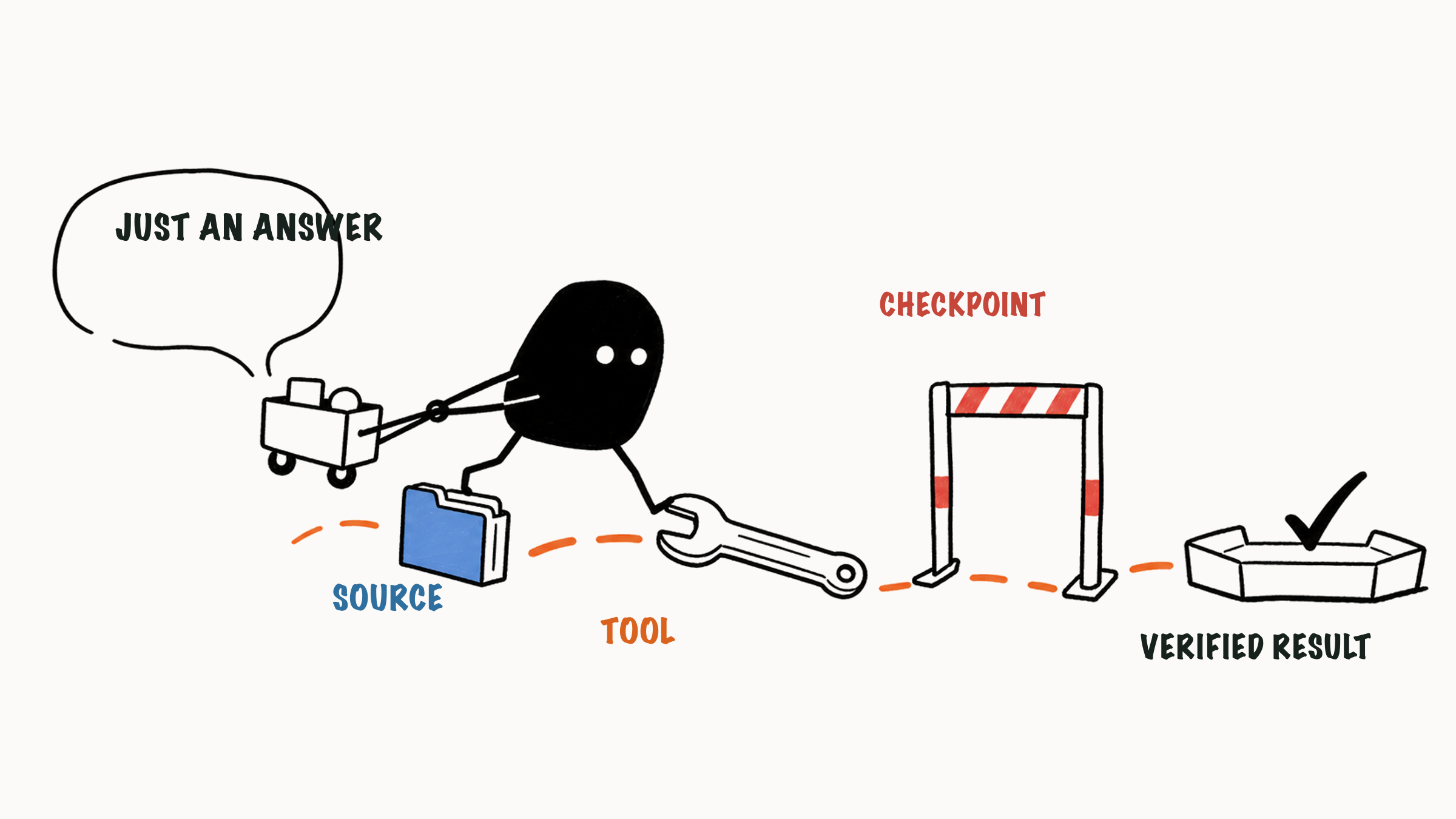
01 Where a chatbot stops
A normal AI chat goes like this:
You ask a question
The AI understands it
The AI writes an answer
You decide what happens next
Type "write a customer follow-up email" and the AI gives you a draft. Its job ends there. Everything after that is up to you or some other system:
Look up the customer's record
Work out what stage the customer is at
Check past conversations
Send the email
Ask "what is RAG?" and the same thing happens: you get an explanation and the exchange ends. The AI hands over an answer, and you decide what to do with it. For plenty of tasks that's all you need, and a plain chat handles them well.
02 Chatbot, assistant and agent
Stay with the follow-up email, but suppose you want the AI to:
Read the customer record
Review recent conversations
Judge which stage the customer is at
Draft a follow-up email
Flag any commitments that need human approval
Wait for your OK before sending
The draft is just one step. The agent needs the record before it can judge the stage, needs the stage before it can write the draft, and then passes the draft's commitments to a person for sign-off. Each step feeds the next, and the email goes from something the AI can generate to something you can approve and send.
Here's how the three kinds of system compare:
| Type | What it does | Example |
|---|---|---|
| Chatbot | Answers, explains, generates text | Writes an email draft |
| AI assistant | Keeps helping through the conversation, or reasons from material you give it | Revises an email over several rounds; decides from a policy whether a refund is allowed |
| Agent | Chooses or adjusts its actions based on what it finds | Sees that the customer record is incomplete, looks up the missing piece, then drafts the email for approval |
Three customer-service requests make the line even clearer:
| Request | What the AI does | Closest to |
|---|---|---|
| Explain the refund policy | Writes an explanation | Chatbot |
| Based on this policy, can this customer get a refund? | Makes a judgment from the material provided | AI assistant |
| Checks the order, finds information missing, looks it up, and drafts a recommendation for approval | Picks its next action from a result | Agent |
Each example adds more data, tools, state and business actions. One product can mix these abilities, and "assistant" is sometimes just a brand name for an agent, so sort products by what they actually do. Then ask who decides the next step.
03 Fixed workflow versus agent
Fixed workflows are what people most often mistake for agents. Here are two systems that both handle refunds:
System A (fixed workflow)
  receive request -> look up order -> match against a rules table -> write reply
  The steps and branches live in code. The model only words the final reply.

System B (agent)
  look up order -> notice the shipping record is missing -> model chooses to look it up
                -> continue based on the result, or ask a person to confirm
  The model picks each next step from the goal and the results so far.
Both call tools. The difference is where the next step comes from: in A it's written in code, and in B the model chooses it. You could object that A might also have a "look up shipping if missing" branch, which looks like acting on conditions too. So the real test is this: did a programmer decide the choice in advance, or did the model make it from this particular result?
Anthropic draws the same line in Building effective agents. Workflows run models and tools through predefined code paths, while in agents the model directs its own process and tool use. The number of steps doesn't decide which one you have.
Put simply: if the program fixes every step and the model only writes text inside them, you have a fixed workflow. If the model looks at an order lookup and decides whether to dig deeper, carry on or ask for approval, you have an agent moving a task forward.
An agent's output can also be a research report, and sending an email or editing an order is just one kind of action it might take. Compare two research assistants:
A: The program searches three fixed websites in order, then asks the model to write a report.
B: The model notices two sources conflict, chooses to go back to the original file, then decides whether it can draw a conclusion.
A's steps are set in advance, so it's a fixed workflow. B chooses its actions from intermediate results, which is the agent trait. Both deliver a report, so what matters is how the actions get decided. If all you know is that "it searches and writes a report," you still need to find out how it's controlled.
An agent can still wait for your approval before it acts. Approval limits what it may execute, and the model keeps its ability to choose the next action.
04 Four questions to ask
When a product calls itself an agent, ask these in order:
1. After one answer, does it wait for a person to decide what's next?
   Yes -> closer to a chatbot or conversational assistant
   No  -> see how it keeps going

2. Are all later steps fixed in advance by the program?
   Yes -> closer to a fixed workflow, however many steps it has
   No  -> check whether the model picks tools, adjusts its actions or stops based on results

3. Does it keep the state it needs to continue the task?
   Yes -> it builds on what's done instead of starting over each time
   No  -> look for gaps in task continuity

4. Are permissions and high-risk actions under control?
   Yes -> there are boundaries; still test whether execution respects them
   No  -> even if it has agent abilities, it's risky to use
Two cases come up often:
- Some products call themselves agents but are really a very long prompt, with no tools, data, state or approval points. At heart they're still plain chat.
- Some products never mention agents, yet pick their next step from what a tool returns and stop to ask before key actions. They have the core structure of an agent.
Name these visible traits first, then judge by actual behavior.
05 A one-line definition and its parts
Here's the whole idea in one sentence:
Agent = an AI system that works toward a goal, uses data and tools within set boundaries, and chooses or adjusts its actions based on intermediate results.In practice an agent needs at least three parts:
Task instructions: it knows what to do
Boundaries: it knows what it must not do
Tools: it can use certain abilities to get things done
The instructions say what to accomplish. Boundaries limit what the agent may do, which cuts down on overreach, guessing and mistakes. Tools let it look things up and operate systems. For a simple customer-service agent:
| Part | In a customer-service agent |
|---|---|
| Task instructions | Help handle refund requests using orders and policy |
| Boundaries | No promising compensation, no inventing policy, no acting beyond its authority |
| Tools | Look up orders, search policies, create tickets, draft replies |
If a task is interrupted, the agent also needs to record its state. Say a customer-service agent has checked the order, drafted a reply and stopped at the approval point. When you come back, it has to know what it has looked up, what the draft says and what's left to do. Without that, it may repeat lookups or treat an unapproved draft as already sent. Keep three lists: what's done, what's waiting for approval, and what's still to do. A plan that only says "handle refunds intelligently" leaves the way the task moves forward undefined.
Next time you meet a new AI feature, ask one thing: after it answers, who decides what happens next? Of the three parts, the task instructions are the one people most often leave vague. For how to write them well, read the four elements of an agent task instruction.